
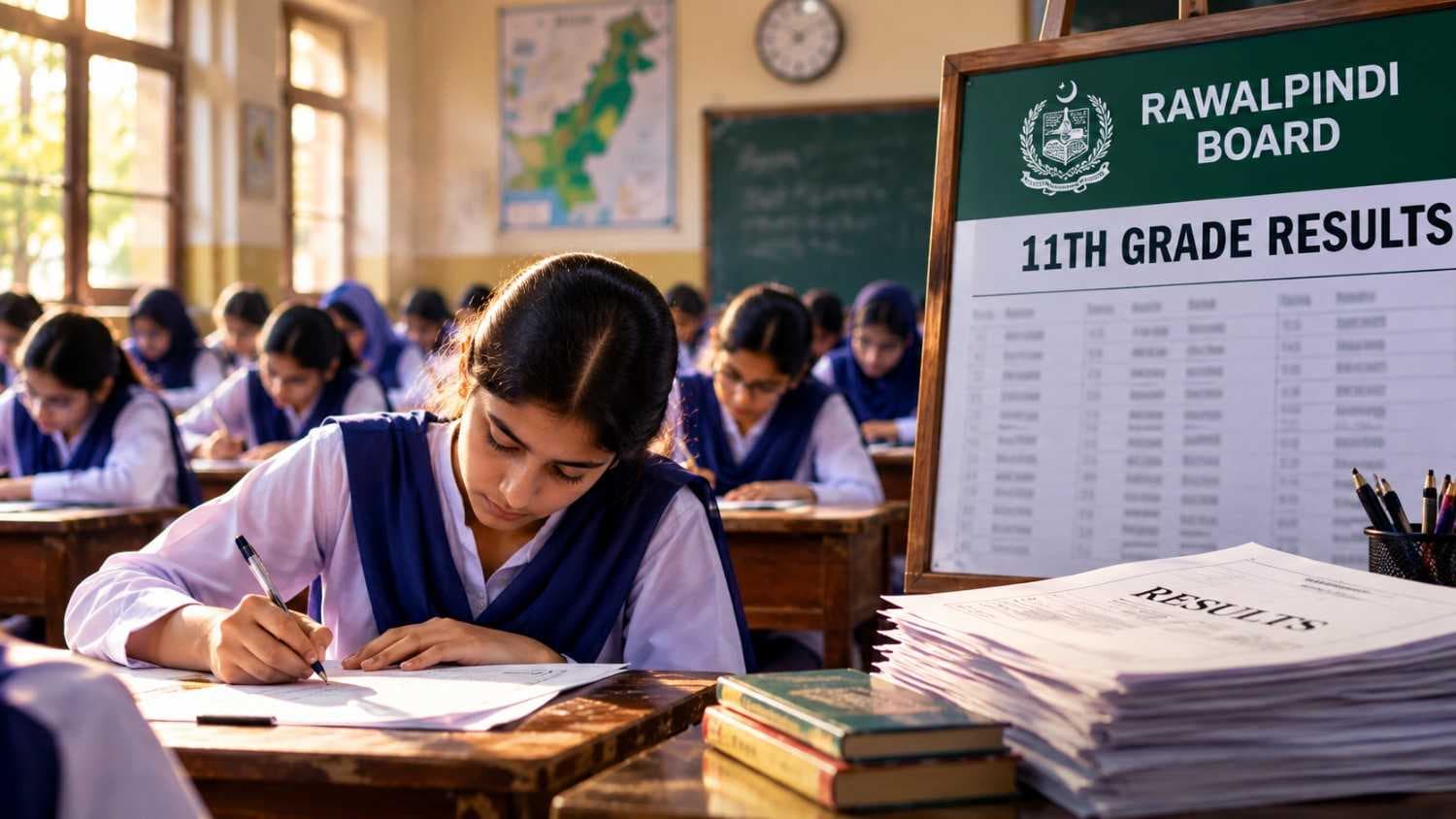
1. Rawalpindi Board Announces Class 11 Results for 2026
The Board of Intermediate and Secondary Education (BISE) Rawalpindi announced the results of the Higher Secondary School Certificate (HSSC) Part-I annual examinations on October 22, 2026, revealing that more than 25,000 candidates were unsuccessful.
According to figures reported by the Associated Press of Pakistan (APP), approximately 55,834 students appeared in the examinations, while 30,280 candidates passed, resulting in an overall pass rate of approximately 54.23%.
The results have attracted considerable attention among students, parents and educational institutions across the Rawalpindi division, particularly because a substantial proportion of candidates did not achieve passing results.
BISE Rawalpindi conducts intermediate examinations for students enrolled in affiliated educational institutions across its jurisdiction.
Class 11, also known as HSSC Part-I or Intermediate Part-I, represents the first year of the two-year intermediate education programme.
Students from science, humanities, commerce and other academic streams participate in these examinations, which contribute to their overall higher secondary academic records.
The announcement provides students with an opportunity to assess their performance and identify subjects requiring additional preparation before their final-year examinations.
Key highlights of the 2026 results include:
Examination board: Board of Intermediate and Secondary Education, Rawalpindi.
Examination: HSSC Part-I Annual Examination 2026.
Result announcement: October 22, 2026.
Candidates appeared: Approximately 55,834.
Candidates passed: 30,280.
Reported unsuccessful candidates: More than 25,000.
Overall pass percentage: Approximately 54.23%.
The figures indicate that nearly half of the candidates who appeared did not secure a complete passing result.
However, students should distinguish between failing one or more subjects and failing an entire academic programme, as examination regulations may allow candidates to address unsuccessful subjects through subsequent examinations.
The precise status of each candidate should be determined through their official result record and the board's applicable examination rules.
2. Official Statistics Highlight Gender Gap and Improvement Over 2025
The examination results also revealed differences in academic performance between male and female candidates.
According to published figures attributed to BISE Rawalpindi, female candidates recorded a considerably higher pass percentage than male candidates.
Female students achieved a reported pass rate of approximately 62.13%, compared with 38.54% among male students.
The figures indicate a substantial gender gap in examination outcomes, although the available statistics do not establish the reasons behind the difference.
Reported examination statistics:
Total candidates appeared: 55,834.
Total candidates passed: 30,280.
Overall pass rate: 54.23%.
Female candidates appeared: 37,138.
Female candidates passed: 23,075.
Male candidates appeared: 18,696.
Male candidates passed: 7,205.
The reported number of candidates who passed is consistent with the combined male and female pass counts.
However, some published reports have cited 25,548 unsuccessful candidates, while subtracting the reported number of successful candidates from the total who appeared produces 25,554.
This six-candidate discrepancy has not been reconciled in the figures available for this article. Therefore, Radar Pakistan is using the independently supportable description “more than 25,000 unsuccessful candidates” rather than presenting an exact failure total.
The overall pass percentage of 54.23% is consistent with the reported number of successful candidates and total appearances when rounded to two decimal places.
The latest results also suggest an improvement compared with the previous academic year.
Published reports placed the 2025 HSSC Part-I pass percentage at approximately 43.46%, compared with 54.23% in 2026.
This represents an improvement of approximately 10.77 percentage points.
Despite the increase, the latest results highlight the importance of addressing learning gaps, strengthening examination preparation and supporting students who have struggled academically.
Educational institutions may use the results to assess subject-level performance and develop targeted academic support programmes.
The statistics also underline the importance of evaluating academic performance through broader factors, including access to educational resources, teaching quality and student preparation.
3. How Students Can Check Their Results and Prepare for the Next Academic Year
Following the announcement of the HSSC Part-I results, students can check their examination records through the official BISE Rawalpindi website and its designated result services.
The board's online system allows candidates to access their individual examination information using their roll numbers.
Students are advised to verify their marks and personal details carefully and contact the relevant board authorities if they identify discrepancies.
Available methods for checking results include:
Official website: Visit BISE Rawalpindi and open the online results section.
Result portal: Access BISE Rawalpindi Results and select the HSSC Part-I Annual Examination 2026.
Roll number: Enter the roll number printed on the examination slip to view the result.
SMS service: Send the examination roll number to 800296 to receive available result information.
Result gazette: Consult the board's published result gazette for detailed examination records.
Rechecking: Follow the board's official instructions and deadlines for requesting a review of marks or answer scripts.
The online and SMS result-checking methods have also been reported by education news outlets covering the October 22 announcement.
Students who did not achieve their expected results should review their subject-wise performance and consult teachers or academic advisers about appropriate next steps.
Educational institutions can play an important role by identifying subjects in which students performed poorly and offering additional guidance, revision sessions and examination preparation support.
Candidates seeking to improve their academic performance should confirm the board's applicable rules regarding unsuccessful subjects, subsequent examinations and eligibility requirements.
The Class 11 results provide an important indication of students' academic progress, but they do not determine their entire educational future.
With appropriate preparation, academic support and timely access to official information, students can make informed decisions about their next stage of education.
The 2026 results reflect an improvement in the overall pass rate compared with 2025, while also demonstrating the need for continued efforts to improve educational outcomes across the Rawalpindi division.
Editor's Note
Radar Pakistan will continue monitoring official announcements from BISE Rawalpindi, including result statistics, rechecking procedures and updates relevant to students and educational institutions. Candidates are encouraged to verify their individual examination records through the board's official channels.