
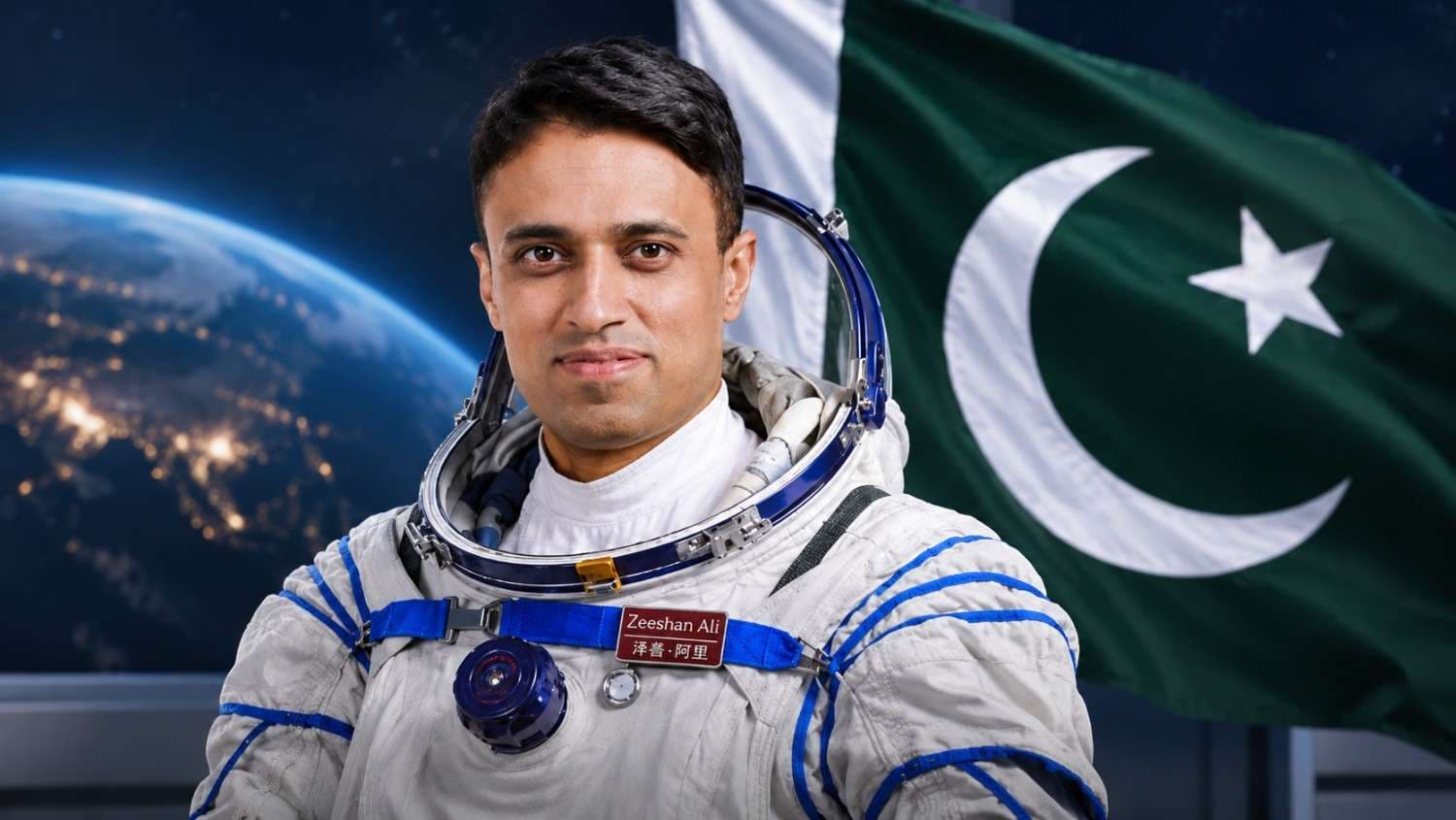
1. Zeeshan Ali Becomes First Pakistani to Reach Earth Orbit
Pakistan has marked a historic achievement in space exploration after Muhammad Zeeshan Ali successfully travelled into Earth orbit aboard China's Shenzhou-24 spacecraft on Wednesday, November 25, 2026.
The three-member crew launched from the Jiuquan Satellite Launch Center in northwestern China aboard a Long March-2F carrier rocket.
The spacecraft lifted off at 8:18 a.m. Beijing time, corresponding to 5:18 a.m. Pakistan Standard Time.
According to the China Manned Space Agency (CMSA), the spacecraft separated successfully from the launch vehicle approximately 10 minutes after liftoff and entered its planned orbit.
The agency confirmed that the astronauts were in good condition following the launch.
The mission's three-member crew includes Chinese astronauts Tang Hongbo and Wu Yi, alongside Pakistani astronaut Muhammad Zeeshan Ali.
Tang Hongbo is serving as mission commander, Wu Yi as flight engineer and Zeeshan Ali as payload specialist.
The spacecraft subsequently completed a successful automated docking with the Tiangong space station at 11:56 a.m. Beijing time, or 8:56 a.m. in Pakistan.
The docking took place at the forward port of the station's Tianhe core module, approximately three hours and 38 minutes after launch.
The mission represents a major achievement for Pakistan's growing space programme and China's expanding international space cooperation.
Key details of the historic mission:
Pakistani astronaut: Muhammad Zeeshan Ali.
Age: 40 years.
Mission: Shenzhou-24.
Launch date: November 25, 2026.
Pakistan launch time: 5:18 a.m.
Launch location: Jiuquan Satellite Launch Center, China.
Rocket: Long March-2F.
Destination: Tiangong space station.
Mission commander: Tang Hongbo.
Flight engineer: Wu Yi.
Payload specialist: Muhammad Zeeshan Ali.
Successful docking: 8:56 a.m. Pakistan time.
Expected Pakistani astronaut's stay: Approximately five to ten days.
Ali has become the first Pakistani to reach Earth orbit, distinguishing his achievement from the country's earlier suborbital spaceflight milestone.
In October 2023, Pakistani adventurer Namira Salim travelled to suborbital space aboard Virgin Galactic's Galactic 04 mission.
Unlike that shorter journey, the Shenzhou-24 mission involves sustained orbital flight and scientific work associated with an operational space station.
At the time of the initial docking confirmation, the crew's entry into the station was the next scheduled step.
2. Pakistani Astronaut to Conduct Scientific Research Aboard Tiangong
Muhammad Zeeshan Ali's participation goes beyond the symbolic significance of carrying Pakistan's flag into orbit.
As a payload specialist, he will support scientific experiments developed through cooperation between Pakistani and Chinese research institutions.
According to SUPARCO, Pakistan's Space and Upper Atmosphere Research Commission, the programme includes research involving biotechnology, advanced materials and biological systems under microgravity conditions.
The mission provides an opportunity for Pakistani researchers to investigate how materials and living organisms behave outside Earth's normal gravitational environment.
Four areas of research highlighted by SUPARCO include:
1. Advanced composite materials
Researchers will examine lightweight, graphene-based composite materials that could potentially improve spacecraft protection against radiation while reducing structural weight.
2. Self-healing materials
Experiments will explore whether specially developed carbon-fibre materials can repair small structural cracks, potentially improving the durability of future spacecraft.
3. Quinoa seeds in space
Scientists will study how microgravity and space radiation affect quinoa seeds, including their biological characteristics and potential use in future space-related food research.
4. Microalgae and cyanobacteria
Research will investigate biological systems that could contribute to oxygen production, carbon dioxide removal and sustainable food sources during extended missions.
These studies are experimental and do not establish that the proposed technologies are ready for operational deployment.
Ali's mission is expected to last approximately five to ten days before he returns to Earth aboard the Shenzhou-23 spacecraft, subject to mission arrangements.
The broader Shenzhou-24 crew will also support station maintenance, scientific activities and the handover from the previous crew.
The CMSA has outlined approximately 90 scientific and technical experiments during the mission.
Why the research matters for Pakistan:
Provides experience in orbital scientific experimentation.
Strengthens cooperation between Pakistani and Chinese researchers.
Supports the development of advanced materials technologies.
Expands opportunities for biological research in space.
Creates training opportunities for future Pakistani specialists.
Encourages greater participation in international space missions.
The scientific outcomes will depend on experiment execution, data collection and subsequent analysis.
The results are expected to contribute to longer-term research programmes rather than deliver immediate commercial applications.
3. Historic Spaceflight Strengthens Pakistan–China Scientific Cooperation
The successful launch reflects an expanding partnership between Pakistan and China in space technology and scientific research.
In February 2025, the two countries signed a cooperation agreement covering the selection and training of Pakistani astronauts for participation in China's space station programme.
The agreement created a formal pathway for Pakistan to take part in a Chinese crewed space mission.
Muhammad Zeeshan Ali subsequently travelled to China in April 2026 for specialist astronaut training.
His preparation included spacecraft operations, emergency procedures, scientific experiments, physical conditioning and communication with Chinese crew members.
The programme also required language training to support safe and effective coordination during the mission.
The Shenzhou-24 flight represents the first time a foreign national has participated in China's space station crew programme.
The development has attracted international attention because China is seeking to expand cooperation with other countries in human spaceflight and space-based research.
Pakistan's government welcomed the successful launch.
Prime Minister Shehbaz Sharif congratulated the nation, describing the achievement as an important moment for the country's scientific and technological ambitions.
Deputy Prime Minister and Foreign Minister Ishaq Dar also praised the mission, linking the development to the longstanding relationship between Pakistan and China.
Planning Minister Ahsan Iqbal attended the launch activities in China and highlighted the importance of encouraging Pakistani youth to pursue scientific and technological fields.
The mission takes place during the 75th anniversary of diplomatic relations between Pakistan and China.
Potential long-term benefits include:
Space research: Expanding Pakistan's involvement in orbital experiments.
Astronaut training: Developing experience relevant to future human spaceflight programmes.
Scientific education: Inspiring students to study engineering, physics and related disciplines.
Technology cooperation: Strengthening collaboration between Pakistani and Chinese institutions.
International partnerships: Opening possibilities for participation in future missions.
National development: Supporting broader ambitions in science, research and advanced technology.
Pakistan has also been developing its space capabilities through satellite projects and cooperation with international partners.
The Shenzhou-24 mission extends that involvement into orbital human spaceflight.
However, participation in this mission does not mean Pakistan has independently developed its own crewed launch vehicle or space station.
The achievement has been made possible through cooperation with China's established human spaceflight infrastructure.
For Pakistan, the mission represents an opportunity to build expertise and pursue more ambitious scientific projects in the future.
The successful launch and docking on November 25 mark an important milestone, while Ali's planned scientific work and safe return will be the next major developments to monitor.
Editor's Note
Radar Pakistan will continue monitoring Muhammad Zeeshan Ali's historic Shenzhou-24 mission, including the crew's entry into China's Tiangong space station, scientific experiments and the Pakistani astronaut's eventual return to Earth. The successful orbital launch and docking were officially confirmed by the China Manned Space Agency on November 25, 2026. Further updates will be published as new mission information becomes available.