1. Pakistan and Russia Sign Major Anti-Corruption Cooperation Agreement
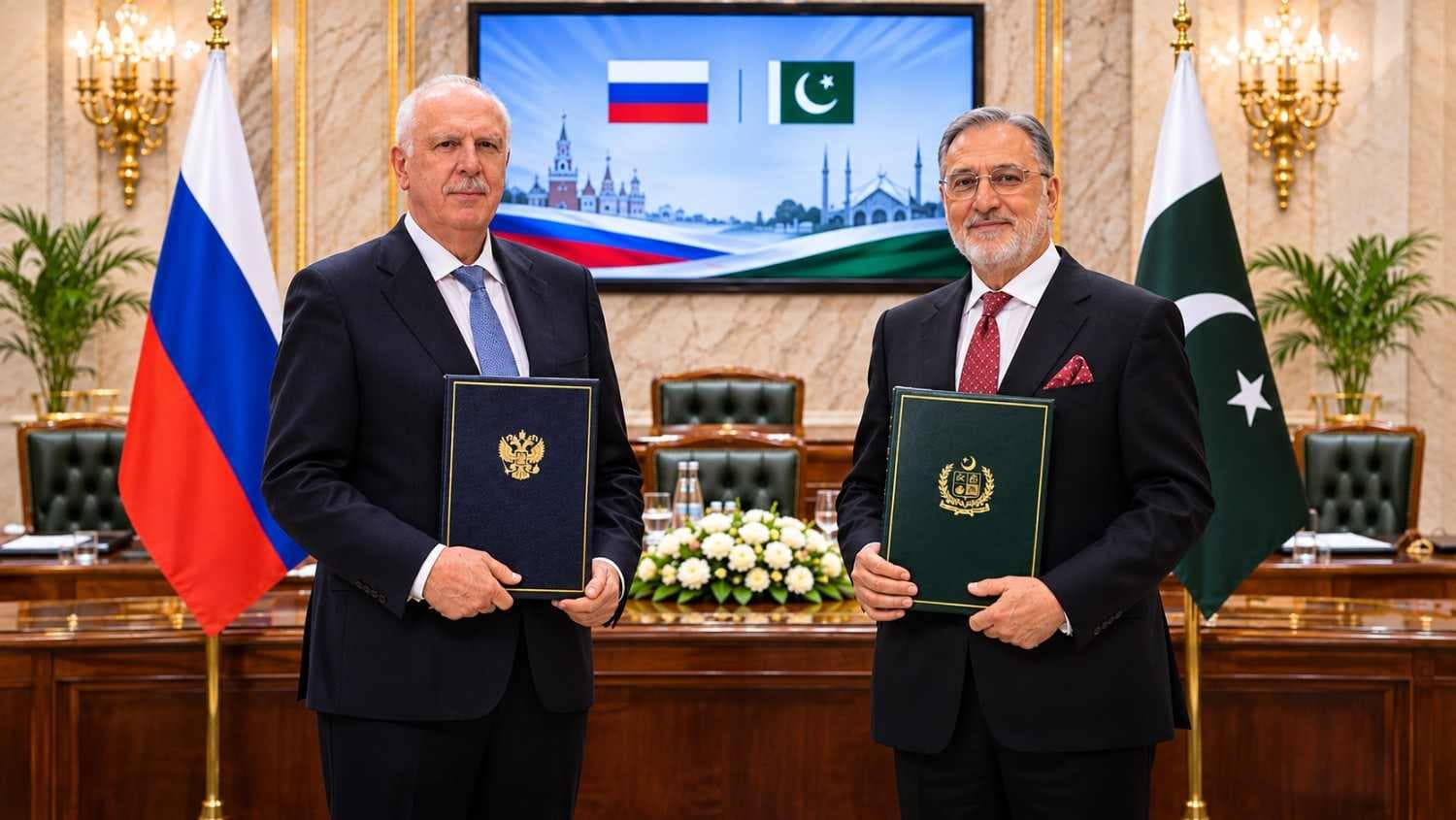
Pakistan and Russia have formally signed a memorandum of understanding (MoU) to strengthen cooperation in combating corruption, money laundering and related financial crimes.
The agreement was signed on Friday, November 6, 2026, between Pakistan's National Accountability Bureau (NAB) and the Prosecutor General's Office of the Russian Federation.
The signing ceremony took place in Moscow, according to Russian news agency Interfax and other reports.
NAB Chairman Lieutenant General (retd) Nazir Ahmed signed the agreement alongside Russian Prosecutor General Aleksandr Vladimirovich Gutsan.
According to an official statement issued by Pakistan's Press Information Department (PID), the agreement aims to promote transparency, accountability and stronger coordination between the two countries' relevant institutions.
The MoU establishes a formal mechanism for sharing expertise, exchanging institutional experience and cooperating on investigations involving corruption and money laundering.
The initiative reflects the growing importance of international cooperation in addressing financial crimes that can involve multiple jurisdictions.
Key details of the agreement:
Countries: Pakistan and Russia.
Agreement date: November 6, 2026.
Signing location: Moscow, Russia.
Pakistani institution: National Accountability Bureau (NAB).
Russian institution: Prosecutor General's Office of the Russian Federation.
Pakistani signatory: Lt Gen (retd) Nazir Ahmed.
Russian signatory: Aleksandr Vladimirovich Gutsan.
Agreement type: Memorandum of Understanding (MoU).
Primary objectives: Combating corruption, money laundering and strengthening cooperation on asset recovery.
The agreement represents a significant development in institutional relations between Pakistan and Russia.
However, the MoU should be understood as a framework for future cooperation rather than confirmation that specific investigations have already produced recoveries or criminal convictions.
2. Agreement Focuses on Asset Recovery, Information Sharing and Legal Cooperation
A major feature of the Pakistan–Russia agreement is its emphasis on improving the identification, tracing and potential recovery of assets connected to corruption and money laundering.
Financial crimes can involve the transfer of funds or assets across national borders, creating challenges for investigators working within individual jurisdictions.
International coordination can help institutions exchange relevant information, understand foreign legal procedures and pursue appropriate assistance in criminal investigations.
Under the agreement, NAB and the Russian Prosecutor General's Office will cooperate in several areas related to financial crime prevention and accountability.
According to the official Pakistani statement, the MoU covers the exchange of professional experience, legal knowledge and investigative practices.
Both institutions also intend to consult on matters relating to mutual legal assistance in criminal cases and cooperation between law enforcement authorities.
Major areas of cooperation include:
Asset tracing: Coordinating efforts to identify assets potentially linked to corruption or money laundering.
Asset recovery: Supporting lawful procedures for recovering assets derived from financial crimes.
Information exchange: Sharing relevant experience and knowledge concerning anti-corruption investigations.
Legal cooperation: Exchanging information on legislation, legal systems and institutional procedures.
Professional training: Improving the technical capabilities of investigators and other personnel.
Expert visits: Organising reciprocal visits for specialists from both countries.
Joint events: Conducting international conferences, workshops and working meetings.
Research cooperation: Supporting studies and initiatives focused on corruption prevention.
The agreement also includes plans for educational programmes and awareness initiatives aimed at encouraging young people to reject corrupt practices.
Both institutions intend to organise professional exchanges and collaborative activities to strengthen their understanding of financial crime prevention.
These measures could support the development of more effective investigative practices and improve institutional coordination.
However, the tracing or recovery of assets will still depend on applicable laws, available evidence, judicial procedures and cooperation from relevant authorities.
The signing does not establish an automatic mechanism for transferring assets or bypassing the legal requirements of either country.
3. Pakistan–Russia Partnership Could Strengthen Financial Crime Prevention
The latest agreement comes as Pakistan and Russia continue expanding cooperation across diplomatic, economic and law enforcement sectors.
In October 2026, Pakistan's Interior Minister Mohsin Naqvi held discussions with Russian Interior Minister Vladimir Kolokoltsev on strengthening cooperation against organised crime, cybercrime, drug trafficking and illegal migration.
During that engagement, both countries also expressed interest in improving information sharing and coordinating on broader security challenges.
The new NAB agreement builds on that momentum by focusing specifically on corruption, money laundering, institutional accountability and asset recovery.
For Pakistan, cooperation with foreign investigative and prosecutorial institutions can be valuable when suspected financial crimes involve assets, transactions or individuals across different countries.
International coordination can support the collection of evidence, exchange of expertise and understanding of legal requirements in cross-border cases.
The partnership also creates opportunities for Pakistani investigators to benefit from professional training and technical exchanges.
Potential benefits of the agreement include:
Stronger international coordination against financial crimes.
Improved institutional knowledge and investigative practices.
Greater opportunities for lawful asset tracing and recovery.
More effective exchanges on financial crime legislation.
Training and capacity building for anti-corruption personnel.
Expanded bilateral cooperation between Pakistan and Russia.
Increased public awareness about the consequences of corruption.
The agreement may also contribute to wider efforts to promote transparent governance and strengthen confidence in public institutions.
However, its long-term effectiveness will depend on practical implementation, the quality of information exchanged and measurable progress in relevant cases.
The two institutions have expressed their commitment to maintaining professional engagement and developing joint initiatives under the agreement.
Future cooperation may include expert-level meetings, training activities, research projects and consultations on matters involving international financial crime.
The next important development will be the implementation of these activities and any officially confirmed results arising from the cooperation.
For Pakistan, the agreement represents another step toward expanding international partnerships in the fight against corruption and money laundering.
Editor's Note
Radar Pakistan will continue monitoring cooperation between Pakistan's National Accountability Bureau and the Russian Prosecutor General's Office, including implementation of the November 6, 2026, MoU, professional exchanges and any officially confirmed asset recovery developments. The agreement establishes a framework for cooperation and does not itself confirm the recovery of illicit funds or the conclusion of criminal investigations.