
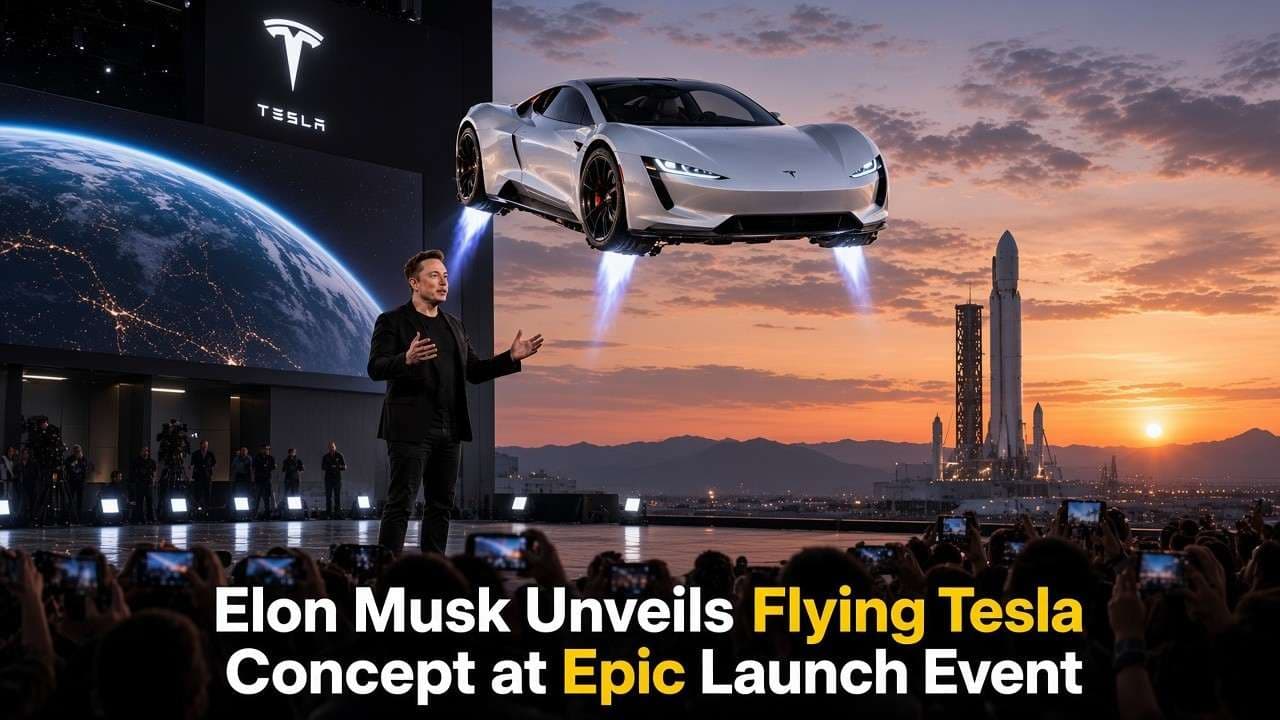
Tesla's next-generation Roadster is one of the most ambitious electric sports cars ever announced. From breathtaking acceleration targets to SpaceX-inspired thrusters that Elon Musk claims could make the vehicle briefly hover, the long-awaited supercar promises to push electric vehicle technology beyond conventional limits.
First unveiled in November 2017, the second-generation Tesla Roadster was designed to demonstrate that electric cars could outperform some of the world's most powerful gasoline-powered supercars. Nearly a decade later, the project continues to attract attention because of its futuristic design, extraordinary performance promises and repeated suggestions of flying capabilities.
However, there is an important distinction between Tesla's original specifications, Musk's later proposals and features demonstrated in a finished production vehicle. Many of the Roadster's most dramatic capabilities remain unverified.
Here are 10 remarkable features that explain why Elon Musk's futuristic Roadster continues to fascinate automotive enthusiasts around the world.
1. SpaceX-Inspired Thrusters That Could Make the Roadster Hover
Perhaps the most extraordinary idea associated with the Tesla Roadster is its proposed SpaceX technology package.
Elon Musk has suggested that the electric supercar could feature compressed-gas thrusters positioned around the vehicle. These thrusters could potentially improve acceleration, braking and cornering by producing additional force.
Musk has also suggested that the system might allow the Roadster to briefly lift off the ground, creating the possibility of a car that can perform limited airborne maneuvers.
Unlike conventional flying-car concepts that use wings or large propellers, the proposed Roadster system would rely on thrust-based technology.
However, the concept should not be confused with a fully functional flying car. Tesla has not established that the Roadster can perform practical, sustained flight as a production vehicle.
2. Acceleration From 0 to 60 MPH in Less Than One Second
Tesla originally introduced the Roadster with a remarkable acceleration target of 0 to 60 mph in just 1.9 seconds.
That figure alone would make it exceptionally quick for a road-going vehicle.
But Musk later suggested that a Roadster equipped with the proposed SpaceX package could complete the same sprint in less than one second.
Achieving such acceleration would require exceptional traction, precise electronic control and advanced engineering to manage the forces experienced by the vehicle and its occupants.
If independently demonstrated in a production vehicle, this capability could set an extraordinary benchmark for electric supercars.
For now, the sub-one-second figure remains a claim rather than an independently verified production result.
3. A Top Speed Target Exceeding 250 MPH
The next-generation Roadster was originally announced with a projected top speed exceeding 250 mph, equivalent to approximately 402 kilometers per hour.
Such performance would put the vehicle in competition with some of the world's fastest exotic sports cars.
Reaching these speeds would require far more than powerful electric motors. Aerodynamic stability, tire technology, cooling systems and vehicle control would all play critical roles.
The Roadster's low-profile body and streamlined design reflect Tesla's ambitions for extreme high-speed performance.
However, its final production top speed has not been independently established.
4. Up to 620 Miles of Claimed Driving Range
One of the Roadster's most ambitious original specifications was a driving range of approximately 620 miles, or nearly 1,000 kilometers, on a single charge.
Tesla associated this target with a proposed 200-kWh battery pack.
If achieved under comparable testing conditions, such a range would be impressive for a high-performance electric sports car.
Long-distance driving range is especially challenging for powerful electric vehicles because battery capacity must be balanced against weight, packaging, efficiency and thermal management.
Actual range would also vary depending on driving speed, weather conditions, road surfaces and acceleration habits.
The 620-mile figure remains an original manufacturer target rather than a verified production range.
5. Three Electric Motors and All-Wheel Drive
Tesla's original Roadster concept featured a three-motor powertrain with one electric motor at the front and two at the rear.
This configuration was intended to deliver exceptional acceleration and all-wheel-drive traction.
By controlling the distribution of power electronically, a multi-motor system can potentially improve handling, stability and responsiveness.
It could also help the Roadster manage the enormous torque associated with high-performance electric propulsion.
The proposed architecture highlights the engineering advantages of electric motors, which can deliver rapid responses to driver inputs.
6. Futuristic Aerodynamic Design
The Tesla Roadster features an aggressive, low-slung design that combines the appearance of a traditional supercar with the clean styling associated with modern electric vehicles.
Its sculpted bodywork, streamlined proportions and low roofline are intended to support aerodynamic efficiency.
At extremely high speeds, air resistance becomes a major challenge, making aerodynamic design essential for both performance and stability.
A carefully engineered body can also reduce energy consumption during ordinary driving.
The Roadster's styling is therefore more than a visual statement. It forms part of Tesla's broader performance ambitions.
7. A Removable Glass Roof
Despite its focus on extreme speed, the Roadster prototype was also designed to provide an enjoyable open-air driving experience.
Tesla showcased the vehicle with a removable glass roof panel that could be stored inside the car.
This design would allow drivers to switch between a closed sports coupe and an open-roof driving experience.
It also gives the Roadster a distinctive character compared with many conventional electric sedans and performance vehicles.
The final production roof design and its practical operation remain subject to Tesla's finalized specifications.
8. Four Seats in a High-Performance Electric Supercar
Another unusual feature of the original Roadster concept is its 2+2 seating arrangement.
While many high-performance supercars are designed for only two occupants, Tesla presented the Roadster with two primary front seats and two smaller rear seats.
The rear seating area is expected to be compact, meaning it may be more suitable for occasional passengers than long journeys.
Nevertheless, the concept demonstrates Tesla's intention to combine extraordinary performance with a degree of everyday practicality.
This approach could help distinguish the Roadster from traditional two-seat exotic sports cars.
9. Advanced Electric Powertrain and Software Technology
Tesla has built much of its automotive identity around electric propulsion, software integration and electronic vehicle management.
The Roadster is expected to benefit from the company's experience in these areas.
Sophisticated powertrain software could help coordinate electric motor output, traction control, energy consumption and battery performance.
Advanced thermal management would also be important for maintaining performance during demanding driving conditions.
However, specific Roadster software features, autonomous driving functions and final charging capabilities should not be treated as confirmed until Tesla releases detailed production specifications.
10. A New Vision for the Future of Electric Supercars
The Roadster's biggest innovation may ultimately be the ambition behind the project.
Elon Musk has repeatedly presented the vehicle as an attempt to challenge expectations about what an electric sports car can achieve.
Its combination of extreme acceleration targets, long-range ambitions, advanced electric propulsion and proposed aerospace-inspired technology makes it an unusual project in the automotive industry.
If Tesla successfully delivers these capabilities in a reliable production vehicle, the Roadster could influence future high-performance electric car development.
The proposed flying functionality remains the most speculative element, particularly because practical airborne operation would introduce significant safety and regulatory challenges.
Can Tesla's Roadster Really Fly?
The term "flying Roadster" has generated enormous interest, but it requires careful explanation.
Musk's proposed thruster system is fundamentally different from the technology used in aircraft designed for sustained flight.
Even if a vehicle could briefly hover or jump using additional thrust, that would not automatically make it a practical flying car.
A commercially viable airborne vehicle would need to address stability, passenger safety, emergency operation, airspace regulations and numerous engineering challenges.
Therefore, Tesla's Roadster is more accurately described as an electric supercar with proposed limited airborne capabilities, rather than a confirmed flying car.
When Will the Next-Generation Tesla Roadster Launch?
The Roadster was originally unveiled in 2017 with expectations of production beginning in the following years.
However, its development has experienced repeated delays, and announced timelines have changed several times.
As a result, earlier launch dates should not be interpreted as reliable confirmation of commercial availability.
Buyers and automotive enthusiasts should rely on Tesla's latest official production announcements for confirmed launch details, pricing and specifications.
Final Verdict: Could the Tesla Roadster Change the Future of Electric Cars?
The next-generation Tesla Roadster remains one of the most ambitious projects in the electric vehicle industry.
With its original 620-mile range target, proposed three-motor powertrain, extreme acceleration ambitions and SpaceX-inspired thruster concept, the Roadster represents an attempt to move electric supercar engineering into unfamiliar territory.
However, the difference between an ambitious prototype and a successful production vehicle is significant.
Tesla must demonstrate that its most impressive claims can be achieved safely, consistently and under real-world conditions.
Whether the Roadster eventually becomes a revolutionary electric supercar or remains an example of extraordinary automotive ambition, it has already helped spark discussion about the future of performance vehicles.
One thing is clear: Elon Musk's Roadster is designed to challenge the limits of electric cars, but its most remarkable promises still need to become verified reality.